Water Softener Benefits — Why Hard Water Costs More Than You Think
Queen Creek’s municipal water supply averages 12 GPG, with peaks reaching 17 GPG in some zones. The EPA classifies anything above 7 GPG as hard water. At 12 GPG, scale builds inside your water heater, pipes, and appliances at a rate that measurably shortens their lifespan and raises your energy bill every year.
A properly installed water softener removes the calcium and magnesium ions driving that damage. The payoff is measurable: water heaters in softened-water homes operate 15–20% more efficiently, produce less scale, and last 2–3 years longer than units running on hard water. That is a $600–$1,500 savings on a single appliance before you account for reduced soap use, longer fixture life, and lower plumbing repair frequency.
Homeowners in Queen Creek, Gilbert, and Chandler consistently report softer skin, brighter laundry, spot-free dishes, and lower detergent use within weeks of installation. The improvement is not cosmetic — it reflects the removal of dissolved minerals that affect every water-using system in the home.
| Benefit | What Changes | Typical Annual Saving |
|---|---|---|
| Water heater efficiency | 15–20% less energy to heat scale-free water | $120–$240/year |
| Appliance lifespan | Water heaters last 2–3 years longer | Avoids $1,000–$2,500 replacement |
| Soap & detergent | Soft water lathers with 30–50% less product | $80–$200/year |
| Pipe protection | Prevents scale narrowing inside copper pipes | Avoids $4,000–$10,000 repiping |
| Fixture life | No pitting or calcium etching on taps and showers | $200–$500 in replacement costs |
Table: Measured benefits of a water softener for Queen Creek homeowners at 12 GPG average
How Does a Water Softener Work — The Ion Exchange Process Explained
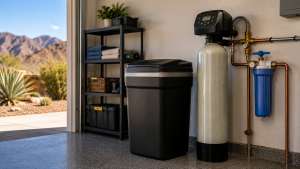
A salt-based water softener works through a process called ion exchange. Hard water enters a tank filled with negatively charged resin beads. Calcium and magnesium ions — which carry a positive charge — are attracted to the beads and stick to them. In exchange, sodium ions attached to the beads are released into the water. The water leaving the tank is chemically soft and safe for pipes, appliances, and skin.
Over time the resin beads become saturated with calcium and magnesium and need to be regenerated. During regeneration, a saltwater brine solution flushes through the tank. The high sodium concentration in the brine pushes the calcium and magnesium off the beads and down the drain, and the beads are recharged with sodium ions ready for the next cycle. Most modern systems run regeneration automatically overnight based on actual water usage rather than a fixed schedule.
The key quality differentiator in softener design is the control valve. Demand-initiated regeneration (DIR) valves regenerate only when the resin is actually exhausted — saving salt and water compared to time-clock models that regenerate on a fixed schedule regardless of need. In Arizona’s hard water environment, DIR systems are the standard recommendation from licensed plumbers.
Best Whole House Water Softener — Sizing for Arizona Hard Water
The correct size for a whole-house water softener depends on two numbers: your household’s daily water usage and your local water hardness. For a three-bedroom Queen Creek home with four occupants at 12 GPG, a 48,000-grain system handles daily demand without regenerating too frequently. Homes in Chandler (19.3 GPG) or Scottsdale (up to 20 GPG) should size up to 64,000 grains to handle the higher mineral load.
Under-sizing is the most common mistake. A unit that regenerates multiple times per day wastes salt and water, and the resin bed wears out faster. A licensed plumber will test your water, calculate your daily softening demand, and recommend the correct grain capacity before any equipment is purchased.
| Home Size | Occupants | Water Hardness | Recommended Capacity |
|---|---|---|---|
| 1–2 bedroom | 1–2 people | 6–12 GPG | 24,000–32,000 grain |
| 3 bedroom | 3–4 people | 12 GPG (QC avg) | 48,000 grain |
| 4+ bedroom | 5+ people | 12 GPG (QC avg) | 64,000 grain |
| 3 bedroom | 3–4 people | 19.3 GPG (Chandler) | 64,000 grain |
| 4+ bedroom | 5+ people | 19.3 GPG (Chandler) | 80,000+ grain |
Table: Recommended water softener grain capacity by home size and water hardness for Queen Creek and Phoenix Metro
How Much Does a Water Softener Cost — Full Installed Price in Arizona
Total installed cost for a water softener in the Queen Creek and Phoenix Metro area runs $950–$2,900, depending on system size and whether your home has a pre-plumbed soft water loop. Equipment accounts for $600–$2,500. Licensed installation labor adds $150–$500. See the full breakdown in our water softener cost guide.
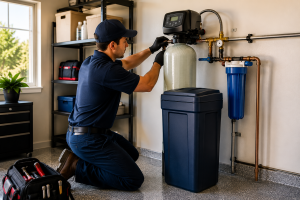
Homes built after 2005 in Queen Creek and Chandler were typically pre-plumbed with a soft water loop — a dedicated connection point in the garage or utility room designed specifically for a softener. If your home has a loop, installation takes 1–3 hours and lands at the lower end of the labor range. Older homes without a loop require the plumber to tap the main supply line and run a drain connection, adding $200–$400 to the job.
| System Type | Equipment Cost | Installation Labor | Total Installed |
|---|---|---|---|
| 32,000-grain salt-based | $600–$900 | $150–$300 | $750–$1,200 |
| 48,000-grain salt-based | $900–$1,500 | $200–$350 | $1,100–$1,850 |
| 64,000-grain salt-based | $1,500–$2,500 | $300–$500 | $1,800–$3,000 |
| Salt-free conditioner | $500–$1,200 | $150–$300 | $650–$1,500 |
| Dual-tank salt-based | $2,000–$3,500 | $400–$600 | $2,400–$4,100 |
Table: Water softener installed cost ranges for Queen Creek and Phoenix Metro (2025–2026)
What Does a Water Softener Do to Your Plumbing — Long-Term Protection
Beyond the visible benefits — spot-free dishes, softer skin, brighter laundry — a water softener provides structural protection to every pipe, joint, and valve in your home. Arizona’s hard water, particularly in Queen Creek and Chandler, creates internal pipe scaling that gradually restricts flow and accelerates corrosion at joints and elbows. Over 15–20 years, this is one of the primary drivers of slab leaks in homes with original copper plumbing.
Soft water is also gentler on fixtures. Hard water pitting on chrome taps and showerheads is caused by calcium deposits etching the surface over time. A softener eliminates this entirely. Premium finishes — brushed nickel, oil-rubbed bronze, matte black — stay intact for their rated lifespan instead of requiring replacement every 3–5 years.
Do You Need a Water Softener in Arizona — The Honest Answer
The Town of Queen Creek’s own FAQ acknowledges that local municipal water measures between 6 and 17 GPG. The EPA classifies anything above 7 GPG as hard. That means Queen Creek regularly runs at 1.7 times the threshold that defines hard water — and can reach 2.4 times that threshold at peak hardness zones.
The only Arizona communities where a water softener is genuinely optional are those served by Colorado River groundwater with lower mineral content — parts of Surprise (2.5–5.3 GPG) being the clearest example. For homeowners in Queen Creek, Gilbert, Chandler, Mesa, and Scottsdale, a water softener is practical home maintenance, not a luxury upgrade.
Frequently Asked Questions
What is the best water softener brand for Arizona hard water?
For Arizona’s extreme hardness (12–20 GPG across the Phoenix Metro), salt-based systems from Rinnai, Fleck, SoftPro, and SpringWell are consistently well-rated by licensed plumbers. The brand matters less than correct grain capacity sizing for your household. A licensed plumber should test your water hardness and size the system before you purchase.
How often do you add salt to a water softener in Queen Creek?
Most Queen Creek households add salt every 6–8 weeks. A 48,000-grain system serving a family of four at 12 GPG average typically uses about 40 lbs of salt per month. Salt bags cost $6–$12 each at hardware stores, making the ongoing cost roughly $6–$20 per month.
Can a water softener damage my pipes?
No. Salt-based water softeners do not damage pipes. Softened water is slightly higher in sodium, but not at levels that affect plumbing materials. In fact, softened water reduces pipe corrosion compared to hard water, which deposits calcium and magnesium scale that narrows pipe diameter and increases internal pressure.
How long does a water softener last in Arizona?
A quality salt-based system, properly maintained, lasts 15–25 years in Arizona conditions. Arizona’s high mineral load means the resin bed works harder than in softer-water states, so annual salt top-ups and a plumber service call every 3–5 years are important for longevity.
Is a salt-free water conditioner as effective as a salt-based softener in Queen Creek?
No. Salt-free conditioners alter how mineral particles behave but do not remove calcium and magnesium from the water. At Queen Creek’s 12 GPG average — and especially at Chandler’s 19.3 GPG — a conditioner cannot match the scale protection and appliance-life benefits of a true salt-based ion exchange softener.
Call Miracle Plumbing & AC — Same-Day Service Available
If you need water softener installation in Queen Creek, Gilbert, Chandler, and Mesa, Miracle Plumbing & AC has been the trusted local choice since 2008. Kirk Todd’s team is licensed, bonded, insured, and available 24/7. Call (480) 544-0057 or visit miracleplumbingaz.com for a free quote. Same-day service available for most calls scheduled before noon.