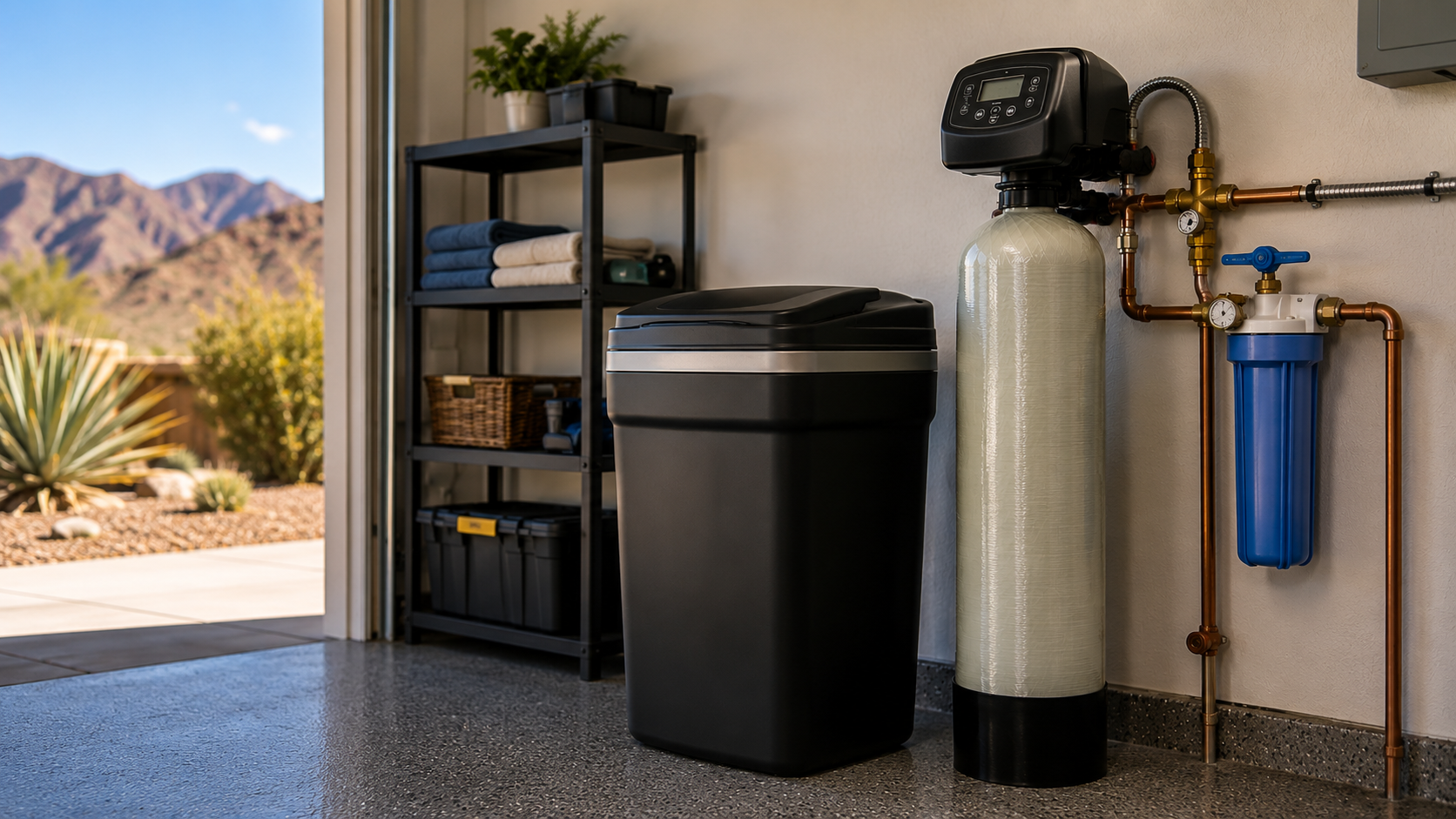
Maintaining a functional plumbing system is crucial for every homeowner, especially in Arizona where water conservation and efficiency are top priorities. At Miracle Plumbing AZ, we understand the challenges that homeowners face, from high water pressure to aging pipes. In this article, we share five essential plumbing tips to help you avoid costly repairs and keep your home running smoothly.
How Much Does a Water Softener Cost — Complete Price Breakdown
The total cost of a water softener in the Phoenix Metro area breaks into three components: equipment, installation labor, and ongoing salt. Homes in Queen Creek averaging 12 GPG typically need a 48,000-grain system. Chandler homes at 19.3 GPG often need 64,000 grains or more. The harder your water, the larger the system required — and the more you save over time.
Equipment cost is the largest variable. A basic 24,000-grain entry-level unit starts around $600. A high-capacity dual-tank system for a large household in a high-hardness zone like Chandler can reach $3,500. Most Queen Creek households land in the $900–$1,800 equipment range for a properly sized 48,000-grain unit.
| System Type | Equipment Cost | Installation Labor | Total Installed | Best For |
|---|---|---|---|---|
| 24,000-grain salt-based | $600–$900 | $150–$280 | $750–$1,180 | 1–2 people, 6–10 GPG |
| 48,000-grain salt-based | $900–$1,500 | $200–$350 | $1,100–$1,850 | 3–4 people, 12 GPG (Queen Creek avg) |
| 64,000-grain salt-based | $1,500–$2,200 | $300–$450 | $1,800–$2,650 | 4+ people or 15–20 GPG |
| Salt-free conditioner | $500–$1,200 | $150–$300 | $650–$1,500 | Not recommended for 12+ GPG |
| Dual-tank salt-based | $2,000–$3,500 | $400–$600 | $2,400–$4,100 | Large households, 24/7 soft water |
Table: Water softener cost breakdown for Queen Creek and Phoenix Metro (2025–2026)
Best Water Softener Systems — What Arizona Conditions Require
Arizona’s water hardness is among the highest in the United States. Phoenix averages 18 GPG. Chandler hits 19.3 GPG. Scottsdale ranges from 12.5 to 20 GPG. At these mineral levels, only salt-based ion exchange systems fully remove calcium and magnesium from the water supply. Salt-free conditioners modify mineral behavior but leave the minerals in the water — which means scale continues to build inside your water heater, dishwasher, and pipes, just at a somewhat slower rate.
For most Phoenix Metro homeowners, the correct choice is a salt-based system with demand-initiated regeneration (DIR). DIR systems regenerate only when the resin is actually exhausted, saving salt and water compared to time-clock models. See our full system comparison in the best water softener system guide.
| Feature | Salt-Based Softener | Salt-Free Conditioner |
|---|---|---|
| Removes minerals | Yes — completely | No — only changes behavior |
| Eliminates scale | Yes | Reduces but does not eliminate |
| Effective at 12+ GPG | Yes | Limited effectiveness |
| Effective at 19+ GPG (Chandler) | Yes | Inadequate |
| Ongoing cost | Salt: $6–$20/month | Filter changes: varies |
| Recommended for AZ | Yes | Not recommended for most AZ cities |
Table: Salt-based softener vs salt-free conditioner comparison for Arizona hard water conditions
How to Install a Water Softener — What the Process Involves
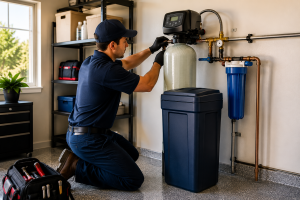
Water softener installation requires a licensed plumber. The system connects directly to your main water supply line — a job that involves cutting into pressurized plumbing, setting up a drain connection for the regeneration cycle, and programming the control valve for your specific water hardness. An incorrectly installed system can cause leaks, pressure problems, or void your equipment warranty. See the full process in our water softener installation guide.
Homes built after 2005 in Queen Creek and Chandler were typically pre-plumbed with a soft water loop — two capped stubs in the garage or utility room that allow a softener to be connected without additional plumbing work. If your home has a loop, installation takes 1–3 hours and costs $150–$300 in labor. Without a loop, add 2–3 hours and $200–$400 for the additional plumbing work.
Water Softeners vs Water Conditioners in Arizona — The Real Difference
‘Salt-free water softener’ is a marketing term, not a technical description. What those products actually are is water conditioners or descalers. They alter the electrical charge of calcium and magnesium particles so they don’t bond to surfaces as easily — but they don’t remove those minerals from the water. The water coming out of a conditioner still tests as hard water on a standard hardness test.
In Queen Creek (12 GPG average), a conditioner will reduce visible spotting somewhat but will not protect your water heater or pipes from scale accumulation at the rate a true softener does. In Chandler (19.3 GPG) or Scottsdale (up to 20 GPG), a conditioner is simply not powerful enough to handle the mineral load. For most Arizona households, a salt-based system is the correct investment.
How Long Do Water Softeners Last in Arizona — Real-World Lifespan
A quality salt-based water softener, properly maintained, lasts 15–25 years in Arizona. The key maintenance tasks are simple: add salt every 6–8 weeks, clean the brine tank annually, and have a licensed plumber service the control valve every 3–5 years. Skipping salt top-ups is the most common cause of early failure — the resin bed runs dry and the unit regenerates with plain water, failing to recharge.
Arizona’s high mineral content means the resin beads work harder than in softer-water states. If your system is more than 10 years old and you’re seeing spots returning on dishes or scale rebuilding on fixtures, schedule a service call before the unit fails completely. Early service typically costs $100–$300. Replacement costs $1,100–$3,000.
Frequently Asked Questions
How much does it cost to install a water softener in Queen Creek?
Total installed cost in Queen Creek typically runs $1,100–$1,850 for a properly sized 48,000-grain system. Homes with a pre-plumbed soft water loop (common in post-2005 builds) land at the lower end. Older homes without a loop add $200–$400 for additional plumbing work. Miracle Plumbing provides free estimates before any work begins.
Is a water softener worth the cost in Arizona?
Yes, for most Phoenix Metro households. At Queen Creek’s 12 GPG average, scale accumulation measurably shortens water heater life, reduces appliance efficiency, and accelerates pipe corrosion. The appliance savings alone — roughly $120–$240 per year in water heating costs, plus avoided replacement costs — typically recover the system cost within 3–5 years.
What are the ongoing costs of a water softener?
Ongoing costs are primarily salt: $6–$20 per month for most Queen Creek households. A 40-lb bag of water softener salt costs $6–$12 at hardware stores and home centers. Every 3–5 years, a licensed plumber should service the control valve — typically $100–$300. Total 10-year operating cost is roughly $1,000–$2,500.
How much does it cost to replace a water softener?
Replacing an existing water softener in a home with an existing soft water loop costs $1,100–$1,850 for most Queen Creek households. This covers a new 48,000-grain unit and 1–3 hours of installation labor. The loop eliminates the cost of additional plumbing work required on older homes without one.
Can I install a water softener myself to save money?
It is not recommended. Water softener installation involves cutting into your main water supply line, which requires skill and the right tools to do leak-free. An improperly connected system can leak, lose pressure, or void your equipment warranty. In most Arizona municipalities, modifications to the main supply line also require a licensed plumber. The labor savings are typically $150–$350 — modest relative to the risk.
Call Miracle Plumbing & AC — Same-Day Service Available
If you need water softener pricing and installation in Queen Creek, Chandler, Gilbert, and Mesa, Miracle Plumbing & AC has been the trusted local choice since 2008. Kirk Todd’s team is licensed, bonded, insured, and available 24/7. Call (480) 544-0057 or visit miracleplumbingaz.com for a free quote. Same-day service available for most calls scheduled before noon.