Signs You Have a Slab Leak: What to Watch For?
Slab leaks happen beneath your concrete foundation underground, invisible, and often silent for weeks or months before obvious symptoms appear. In Queen Creek and the Phoenix Metro, Arizona’s hard water at 12–19.3 GPG accelerates the copper pipe corrosion that causes slab leaks. Homes built in the 1980s and 1990s with original copper plumbing are the most common candidates.
The warning signs of a slab leak are subtle at first. A water bill increase of 20–40% with no change in usage is often the first indicator. Hot spots on the floor warm patches on tile or concrete that persist even when no hot water is running indicate a hot water line leaking beneath the slab. Sound of running water with all fixtures turned off is a definitive sign of an active pressurized leak somewhere in the home.
| Warning Sign | What It Indicates | Urgency Level |
|---|---|---|
| Water bill up 20–40% with no usage change | Active pressurized leak — continuous flow underground | High — investigate within days |
| Hot spot on floor (warm patch on tile) | Hot water pipe leaking beneath slab | High — call same day |
| Sound of running water with all off | Active leak on pressurized supply line | High — call immediately |
| Cracks appearing in walls or flooring | Foundation movement from saturated soil | Medium — schedule assessment |
| Wet or damp floor surface (no spill source) | Water migrating up through slab | High — call same day |
| Low pressure at all fixtures simultaneously | Significant water loss from supply system | High — call immediately |
| Mold smell with no visible mold source | Moisture accumulating in wall cavity or under slab | Medium-high — investigate within 1 week |
Table: Slab leak warning signs and urgency levels for Queen Creek and Phoenix Metro homeowners
How Much Does Slab Leak Repair CostPhoenix Metro Price Breakdown
Slab leak repair in the Phoenix Metro area runs $500–$4,000+ depending on the repair method. Electronic leak detection adds $150–$400 as a separate step before any repair begins — and is essential for accurate, minimal-damage repair. See our leak detection cost guide for the full detection pricing breakdown.
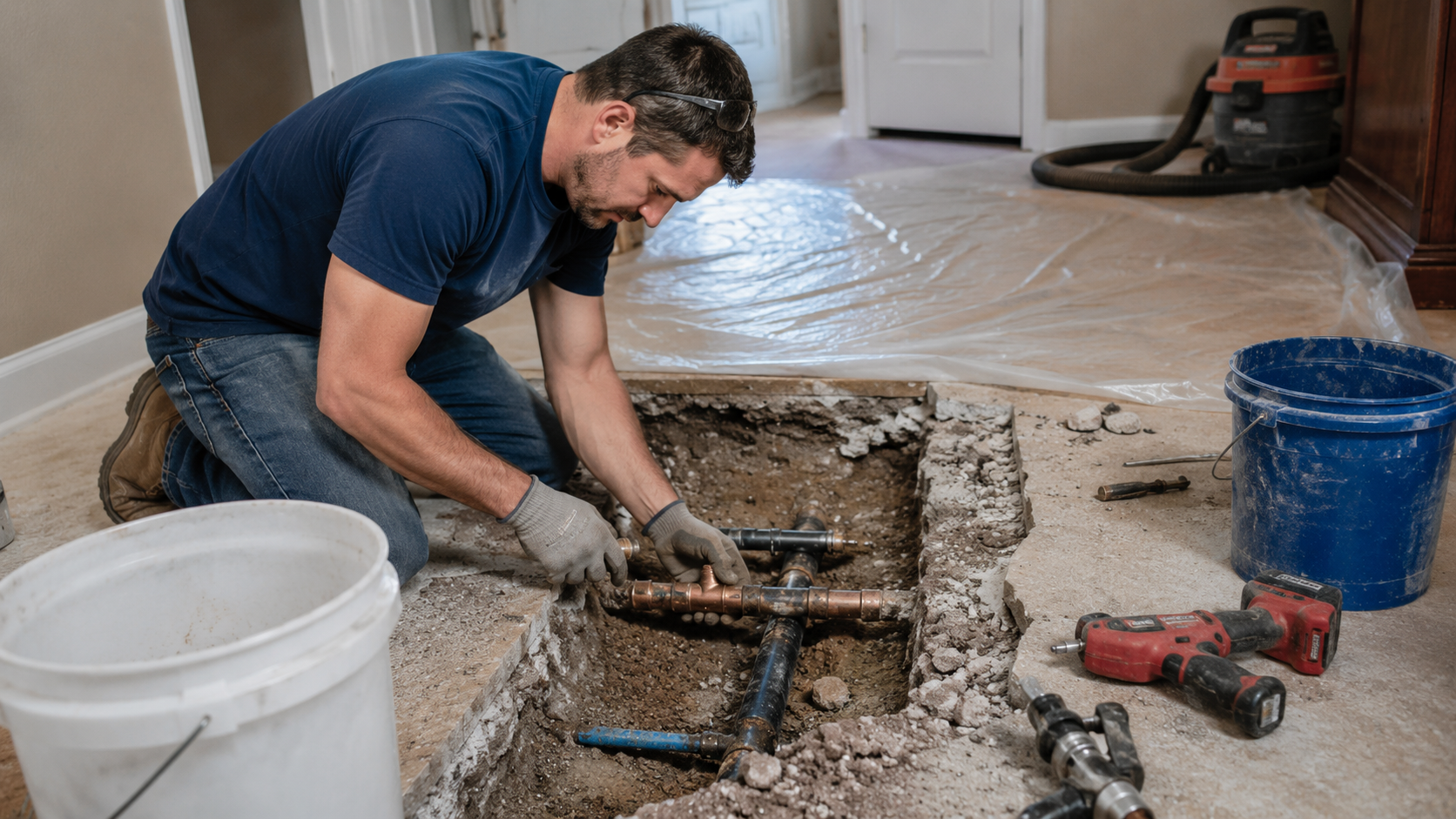
The three repair methods vary significantly in cost, disruption, and long-term effectiveness. Spot repair is the least expensive but only addresses the specific failure point. Pipe rerouting solves the problem by bypassing the slab entirely. Epoxy lining is the least disruptive but requires the pipe to be in reasonable structural condition throughout.
| Repair Method | Cost Range | Disruption Level | Best For |
|---|---|---|---|
| Spot repair (open slab) | $500–$1,500 | Moderate — concrete cut at leak point | Single isolated leak in newer pipe |
| Pipe rerouting (attic/walls) | $1,500–$4,000 | Low — no concrete breaking after detection | Older pipe, multiple leaks, poor access |
| Epoxy pipe lining (trenchless) | $2,000–$5,000 | Very low — no concrete work | Multiple small leaks, structurally sound pipe |
| Full repiping | $4,000–$10,000 | Moderate — 1–3 day project | System-wide deterioration, recurring leaks |
Table: Slab leak repair methods with cost ranges and best applications for Queen Creek, AZ
Slab Leak Repair Methods
Epoxy vs Reroute vs Spot Repair
Choosing the right repair method requires knowing the pipe’s condition beyond just the leak location. A spot repair at the detected leak point is appropriate when the pipe is relatively new, the leak is clearly isolated, and the surrounding pipe walls are in good condition. A licensed plumber confirms pipe wall condition during the repair.
Pipe rerouting running new lines through the attic or walls and bypassing the slab entirely is the preferred method for homes with aging copper pipe that has experienced multiple leaks or shows widespread corrosion. The new line avoids the slab entirely, eliminating the risk of future slab leak repairs at additional points on the same deteriorating system. In Arizona, attic routing is particularly practical given the accessible attic space in most single-story slab homes.
Epoxy pipe lining sprays a coating of epoxy inside the existing pipe, sealing multiple small leaks without breaking concrete. It works well when the pipe structure is sound but pitting or corrosion is causing pinhole leaks at multiple points. It requires thorough pipe cleaning first and is not suitable for pipes with significant corrosion, offset joints, or structural failure.
Does Homeowners Insurance Cover Slab Leak: The Arizona Reality
This is the most common question after a slab leak is discovered. The full answer is in our homeowners insurance slab leak guide. The short version: standard homeowners policies (HO-3) typically cover sudden and accidental water damage — but exclude ‘gradual damage’ including pipe corrosion. Most slab leaks in Arizona are caused by corrosion from hard water, which insurers may classify as gradual rather than sudden.
In practice, what this means for a Queen Creek homeowner: the policy may cover damage to flooring, drywall, and personal property caused by the leak, and may cover the cost of breaking concrete to access the pipe (called ‘access coverage’). The cost of repairing the pipe itself is frequently excluded. Document everything with photos before any work begins and call your insurance company before authorizing repairs.
How Long Does Slab Leak Repair Take:Timeline by Method
Electronic leak detection takes 1–3 hours using acoustic listening equipment and thermal imaging cameras. Miracle Plumbing uses both methods to locate the leak to within inches before any concrete is touched minimizing the area of demolition.
Spot repair takes 2–4 additional hours after detection. Pipe rerouting is typically a full-day job (6–10 hours) depending on the home’s layout and the length of pipe being bypassed. Epoxy lining requires pipe preparation and cure time typically 1–2 days. Miracle Plumbing serves Queen Creek, Chandler, Mesa, Gilbert, Scottsdale, and the full Phoenix Metro. Emergency detection and repair available 24/7.
Frequently Asked Questions
What causes slab leaks in Queen Creek homes specifically?
The primary cause is copper pipe corrosion accelerated by Queen Creek’s hard water (6–17 GPG, average 12 GPG). Hard water creates a chemical environment that corrodes copper pipe from the inside, particularly at joints, elbows, and areas with restricted flow. Arizona’s expansive clay soils add a secondary factor seasonal soil movement creates stress on buried pipes at slab penetration points, which can crack or separate joints over time.
How do I confirm a slab leak before calling a plumber?
Use your water meter. Turn off every fixture, appliance, and irrigation zone in the home. Go to the water meter at the street — usually in a concrete box with a metal lid near the curb. If the meter dial or digital display is moving with everything off, you have an active leak somewhere in the system. Note whether the meter shows continuous movement (large leak) or very slow movement (small leak). Take a photo and call Miracle Plumbing.
Can a slab leak cause foundation damage in Arizona?
Yes. Sustained water discharge beneath a slab saturates Arizona’s clay soil, which expands when wet and contracts when dry. This expansion and contraction creates differential pressure on the concrete slab, which can cause cracking, buckling, and in severe long-term cases, structural settlement. The risk increases with leak duration a slow leak running for months causes significantly more soil disruption than one detected and repaired within days.
How much does emergency slab leak detection cost after hours in Queen Creek?
After-hours and weekend emergency leak detection in Queen Creek and the Phoenix Metro runs $250–$500 the base detection cost of $150–$400 plus an emergency service premium of $100–$150. Miracle Plumbing dispatches within the hour for active flooding or confirmed slab leak emergencies. Call (480) 544-0057 for 24/7 emergency response.
Is spot repair or pipe rerouting better for a Queen Creek home?
It depends on pipe age and condition. For a home under 20 years old with its first slab leak and copper pipe in otherwise good condition, spot repair is often the right choice. For a home built in the 1980s or 1990s with original copper pipe that has had prior leaks or where camera inspection shows widespread wall thinning pipe rerouting prevents the same problem from recurring at a nearby point within 1–3 years.
Call Miracle Plumbing & AC: Same-Day Service Available
If you need slab leak detection and repair in Queen Creek, Chandler, Mesa, and Gilbert, Miracle Plumbing & AC has been the trusted local choice since 2008. Kirk Todd’s team is licensed, bonded, insured, and available 24/7. Call (480) 544-0057 or visit miracleplumbingaz.com for a free quote. Same-day service available for most calls scheduled before noon.