How Much to Install Tankless Water Heater: Arizona Price Summary
In the Phoenix Metro area, expect $1,200 to $3,200 total installed for a gas tankless unit and $900 to $2,500 for an electric model. Full breakdown in our tankless water heater installation guide. Gas units frequently need a gas line upgrade add $300 to $700 for that step. Electric units sometimes need a panel upgrade add $500 to $1,500. These additional costs are confirmed during the free estimate, not discovered afterward.
Miracle Plumbing provides written estimates before any work begins. The estimate covers the unit, all labor, and any identified additional work. If the estimate scope changes during installation; for example, if venting is found to be more complex than expected the team communicates the change and gets approval before proceeding.
How to Install a Water Heater: The Complete Licensed Process
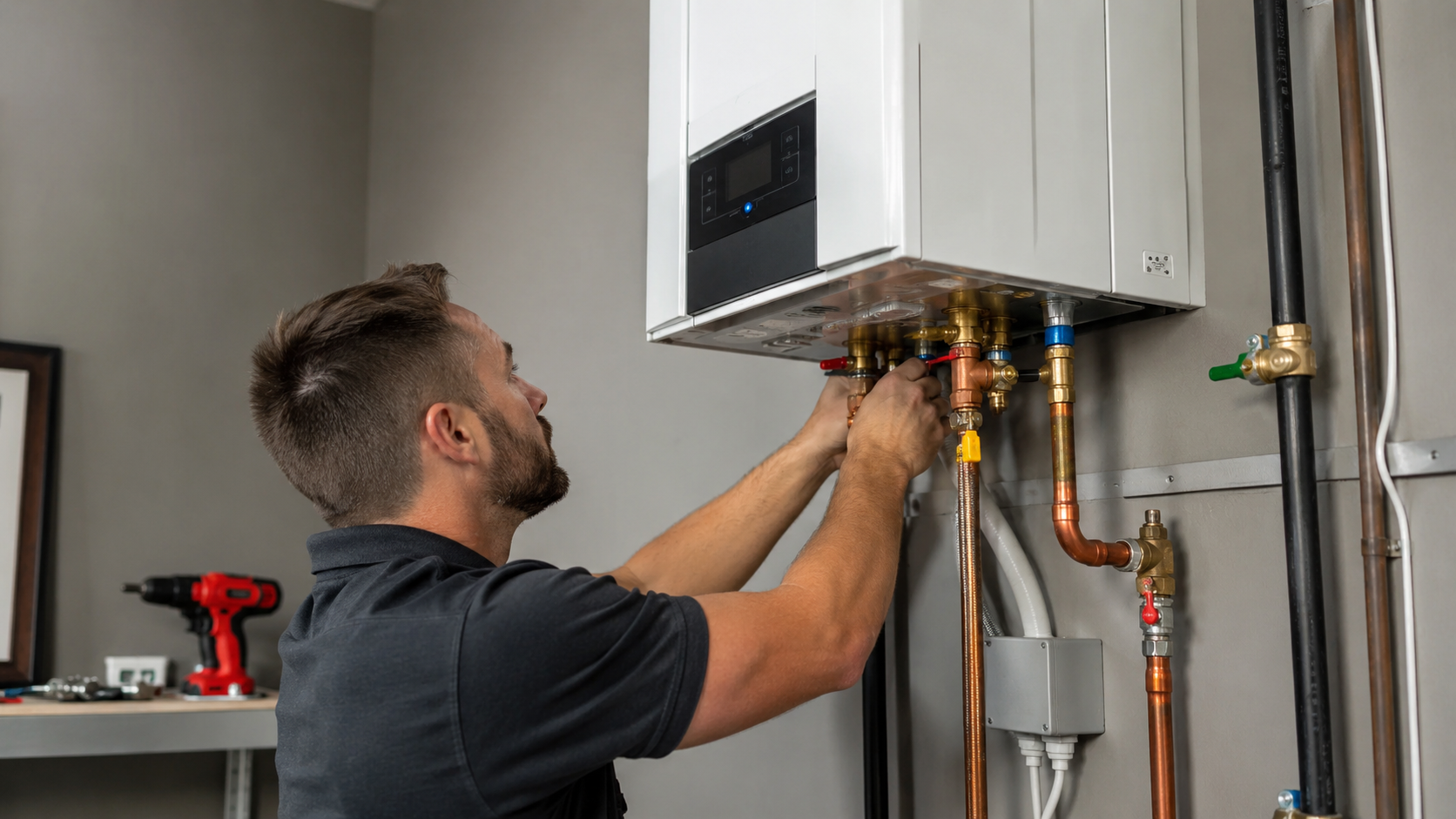
A tankless water heater installation follows a defined sequence. Skipping or rushing steps creates safety hazards and code violations. Here is the full process a licensed plumber follows:
| Step | What Happens | Requires License | Time |
|---|---|---|---|
| 1. Site assessment | Gas line capacity, venting path, panel capacity, water hardness confirmed | No, but critical for accurate scope | 30 to 60 min |
| 2. Shut off utilities | Water, gas or electricity isolated at source | No, but should be verified by plumber | 10 min |
| 3. Drain and remove old unit | Tank drained, disconnected, removed from space | Recommended, gas and electrical connections | 30 to 60 min |
| 4. Gas line upgrade (if needed) | Line resized to correct diameter for BTU demand | Yes, gas fitter / plumber license | 60 to 120 min |
| 5. Mount new unit | Tankless unit mounted per manufacturer spec on wall or exterior surface | No, mechanical work | 30 to 45 min |
| 6. Connect water lines | Cold inlet and hot outlet connected with isolation valves and unions | Yes, plumbing license | 30 to 60 min |
| 7. Install venting system | Direct or power vent system fitted through exterior wall with proper sealing | Yes, plumbing or HVAC license | 45 to 90 min |
| 8. Connect gas or electrical | Final utility connections made, tested for leaks or proper amperage | Yes, gas fitter or electrician | 30 to 60 min |
| 9. Commission and test | Unit powered, flow rate tested, temperature set, error codes checked | No, but plumber should supervise | 30 to 45 min |
Table: Tankless water heater installation steps for Queen Creek and Phoenix Metro licensed steps marked
How Do I Install a Gas Water Heater: The Gas Line Reality for Arizona
The gas line is the most commonly underestimated part of a tankless installation. Standard gas lines running to old tank heaters are typically half-inch black iron pipe, rated for 35,000 to 40,000 BTU. High-output gas tankless whole-house units demand 150,000 to 200,000 BTU, requiring three-quarter inch or larger supply line.
Running a new gas line or upgrading an existing one requires a licensed plumber or gas fitter in Arizona and must pass a pressure test inspection. Miracle Plumbing handles gas line work across Queen Creek, Chandler, Gilbert, and Mesa as part of the tankless installation package. You don’t coordinate separate contractors, it’s all done in one visit.
How to Install Electric Water Heater: Panel and Circuit Requirements
Electric tankless units require a dedicated 240V circuit. Large whole-house electric tankless models may need multiple circuits some requiring 240V at 60 to 150 amps depending on the unit’s heating element configuration. Many older Phoenix Metro homes have 100-amp or 150-amp panels that are already near capacity.
A licensed electrician or qualified plumber must assess the panel before committing to an electric tankless unit. If the panel needs upgrading, the added cost ($500 to $1,500) may make a gas unit the more cost-effective choice for homes where gas is available. Miracle Plumbing confirms panel capacity during the free estimate before any equipment is purchased.
How Long Does It Take to Install a Water Heater: Timeline by Complexity
Standard tank replacement: 2 to 4 hours. Tankless installation replacing a tank (no additional work needed): 4 to 6 hours. Tankless installation with gas line upgrade: 5 to 8 hours. Tankless with gas line upgrade plus new direct-vent penetration through exterior wall: 6 to 10 hours.
Miracle Plumbing schedules full installation days for tankless projects to avoid leaving a job incomplete. Same-day tank replacements are the norm for standard swaps in Queen Creek, Chandler, Mesa, and Gilbert. Tankless installations with significant additional work are scheduled as dedicated half or full-day appointments. Call (480) 544-0057 for a free estimate and scheduling.
Frequently Asked Questions
Can I install a tankless water heater myself in Arizona?
Not legally for gas connections or electrical panel work. Arizona state law requires a licensed contractor for connections to gas supply lines and for electrical work involving the service panel. Even the mechanical mounting and plumbing connections while not legally restricted involve pressure systems that can leak if done incorrectly. The licensing requirement exists because a failed gas connection or improper pressure relief valve installation can cause serious property damage or personal injury.
What is direct-vent installation for a tankless water heater?
Direct-vent means the unit draws combustion air from outside the home through a dedicated intake pipe and expels exhaust through a separate pipe both penetrating the same exterior wall. This eliminates the need for a traditional chimney flue and makes installation more flexible in Arizona homes where garage or utility room walls provide exterior access. The double-pipe penetration must be sealed and insulated correctly to prevent exhaust recirculation.
How do I know if my home’s gas line can support a tankless water heater?
The plumber measures the existing gas line diameter and the distance from the meter to the installation point. These two numbers, combined with the unit’s BTU input requirement, determine whether the existing line can deliver enough gas pressure and volume. A half-inch line 20 feet from the meter can usually supply 75,000 to 100,000 BTU. A 200,000 BTU unit on the same line will not receive enough gas and will underperform. This check takes 15 minutes during the free estimate.
What happens if the wrong size tankless water heater is installed?
An undersized unit runs continuously at maximum output and still cannot keep up with peak hot water demand. You’ll experience temperature drops during simultaneous use cold bursts during a shower when the dishwasher starts, for example. An oversized unit cycles on and off more than necessary and may not reach minimum flow rate for activation. Correct sizing by a licensed plumber during the estimate prevents both scenarios.
Is a tankless water heater harder to repair than a tank unit?
Tankless units have more components gas valves, flow sensors, igniter, heat exchanger, control board and require a plumber experienced with the specific brand for most repairs. Tank units are simpler mechanically. However, tankless units last 15 to 20 years versus 8 to 12 for tanks, so the total number of repair events over a home’s plumbing life is often similar. Miracle Plumbing services all major tankless brands including Rinnai, Navien, Noritz, and Rheem across the Phoenix Metro.
Call Miracle Plumbing & AC: Same-Day Service Available
If you need tankless water heater installation in Queen Creek, Chandler, Mesa, and Gilbert, Miracle Plumbing & AC has been the trusted local choice since 2008. Kirk Todd’s team is licensed, bonded, insured, and available 24/7. Call (480) 544-0057 or visit miracleplumbingaz.com for a free quote. Same-day service available for most calls scheduled before noon.