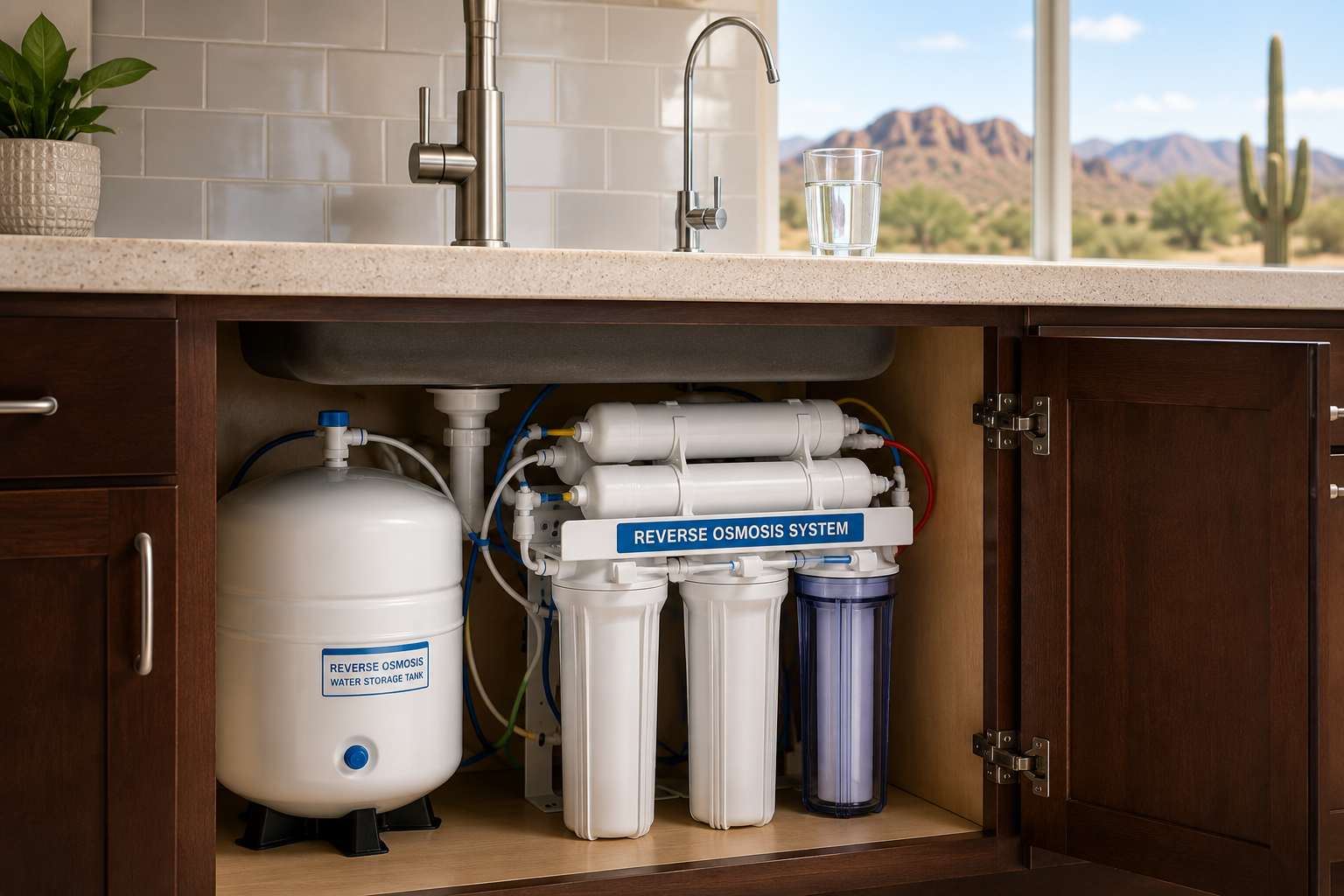
What a Reverse Osmosis Water Filter Removes From Arizona Tap Water
Reverse osmosis works by applying pressure to force water through a membrane with pores measuring 0.0001 microns. Water molecules are small enough to pass through. Dissolved minerals, heavy metals, bacteria, and most chemical compounds are too large and are rejected to a drain line. The result is purified water collected in a pressurized storage tank.
A standard 5-stage under-sink RO system processes water in sequence through a sediment filter, a carbon block pre-filter (critical for Arizona’s chloramine-treated water), the RO membrane, a post-carbon polishing filter, and an optional remineralizer. Each stage has a specific job removing one class of contaminants without damaging the next stage. For a full breakdown of each stage, see our how does reverse osmosis work guide.
Arizona tap water presents a specific challenge for RO systems: chloramines. Most Phoenix Metro municipalities treat water with chloramines rather than plain chlorine a more stable disinfectant that persists longer in the distribution system. Chloramines require a carbon block pre-filter (not granular activated carbon) for effective removal. Using the wrong pre-filter allows chloramines to reach the RO membrane, degrading it within 12 to 18 months instead of the rated 2 to 3 year lifespan.
| Stage | Contaminants Removed | Arizona-Specific Note |
|---|---|---|
| Sediment filter | Dirt, rust, particles | Replace every 6 months, QC sediment load |
| Carbon block pre-filter | Chlorine, chloramines, VOCs | Must be carbon BLOCK for chloramines, not GAC |
| RO membrane (0.0001µm) | TDS, lead, fluoride, nitrates, arsenic, bacteria | 2 to 3 year life with correct pre-filtering |
| Post-carbon polishing | Residual taste and odor | Annual replacement |
| Remineralizer (optional) | Adds Ca/Mg back for taste | Annual replacement |
Table: Reverse osmosis water filter stages with Arizona-specific notes for Queen Creek homeowners
Reverse Osmosis vs Water Softener: Which Does What
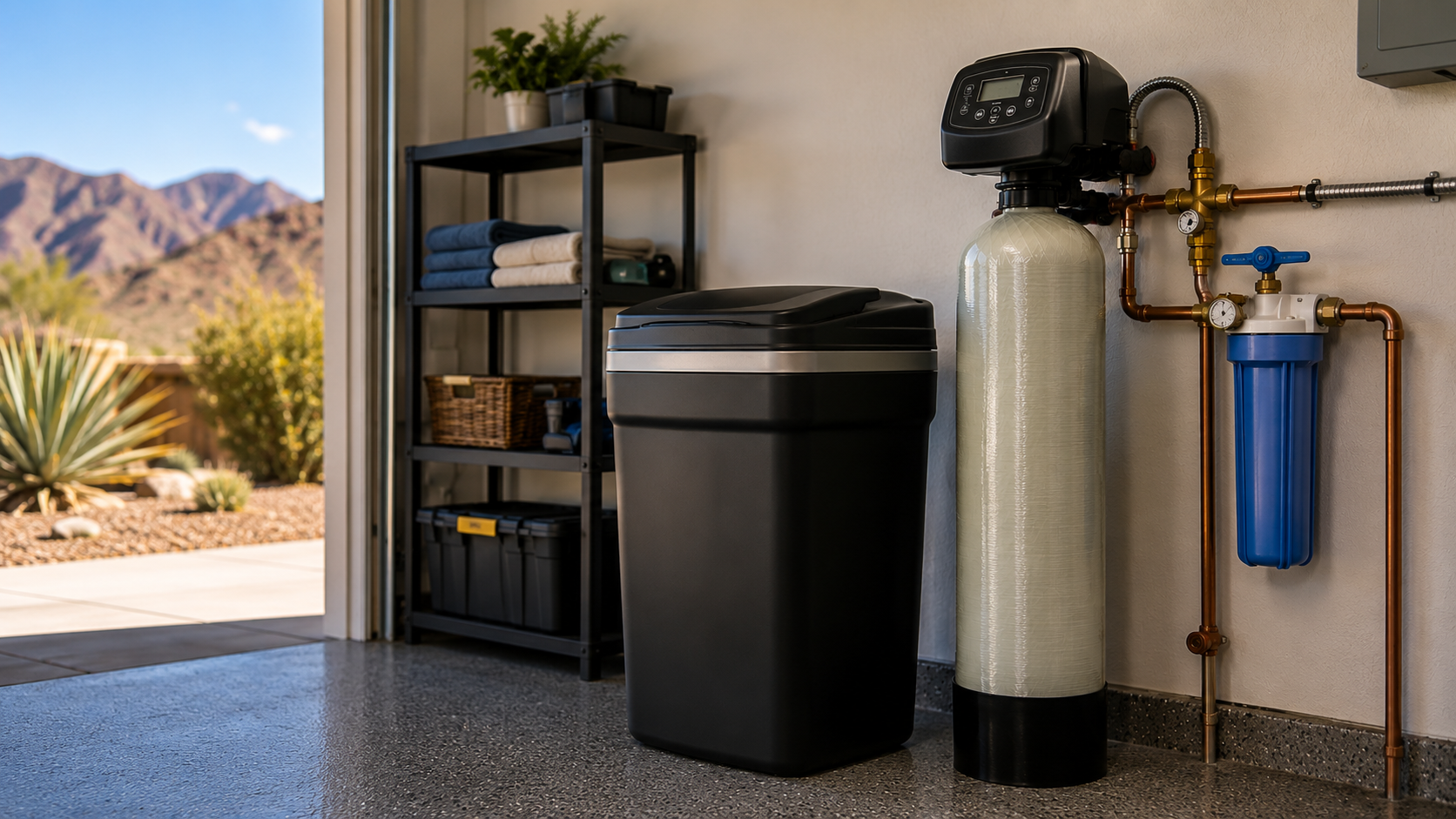
These two systems are often compared as alternatives when they’re actually complementary. A water softener treats all water entering the home removing hardness minerals from every tap, appliance, and pipe. An RO filter treats water at a single point of use the kitchen tap removing a much broader range of contaminants for drinking and cooking.
A water softener does not remove fluoride, nitrates, arsenic, lead, or bacteria. An RO filter does not protect your pipes, water heater, or washing machine from scale damage. Running soft water through an RO system rather than hard water significantly extends membrane life: in Queen Creek’s 12 GPG water, a membrane upstream of no softener lasts 12 to 18 months; downstream of a properly sized softener, it lasts its rated 2 to 3 years.
| Feature | Water Softener | RO Filter | Combined System |
|---|---|---|---|
| Treats | Whole house | Kitchen tap only | Whole house + drinking water |
| Removes hardness minerals | Yes, completely | Partially (at the tap) | Yes, completely |
| Removes fluoride | No | Yes, 85 to 95% | Yes |
| Removes lead | No | Yes, 95 to 98% | Yes |
| Removes chloramine | No | Yes (with carbon block) | Yes |
| Protects pipes & appliances | Yes | No | Yes |
| Installed cost | $950 to $2,900 | $450 to $1,100 | $1,400 to $4,000 |
Table: Reverse osmosis filter vs water softener vs combined system for Queen Creek homeowners
Best Whole House Reverse Osmosis System: When It Makes Sense
Whole-house RO systems treat all water entering the home to drinking quality every tap, every shower, every toilet flush. They cost $2,500 to $6,000 installed, require significant maintenance, and produce significant reject water. For most Queen Creek and Phoenix Metro homeowners on city water, a whole-house RO system is over-engineered and over-priced for what they need.
Whole-house RO is most appropriate for homes on private wells with severe contamination, high arsenic, nitrates, or bacterial presence where the entire water supply poses a health risk. For city water in the Phoenix Metro, a whole-house water softener paired with an under-sink RO at the kitchen achieves the same result for $1,400 to $4,000 total.
How Often to Change RO Filters: Arizona Maintenance Schedule
In Arizona’s hard water and chloramine-treatment environment, RO filters need more frequent attention than the manufacturer’s standard recommendations. Queen Creek water at 12 GPG loads the sediment and pre-filters faster than the national average. The practical Arizona maintenance schedule is: pre-filters every 6 months, post-carbon annually, membrane every 2 to 3 years.
The most reliable way to monitor membrane performance is a TDS (total dissolved solids) meter. Many RO systems include one built into the dedicated faucet. The reject ratio the difference between incoming and outgoing TDS tells you how efficiently the membrane is working. A membrane working below 90% rejection efficiency should be replaced. See our best reverse osmosis system guide for meter placement and reading guidance.
Reverse Osmosis Water Filter Installation Near Me: Queen Creek and Phoenix Metro
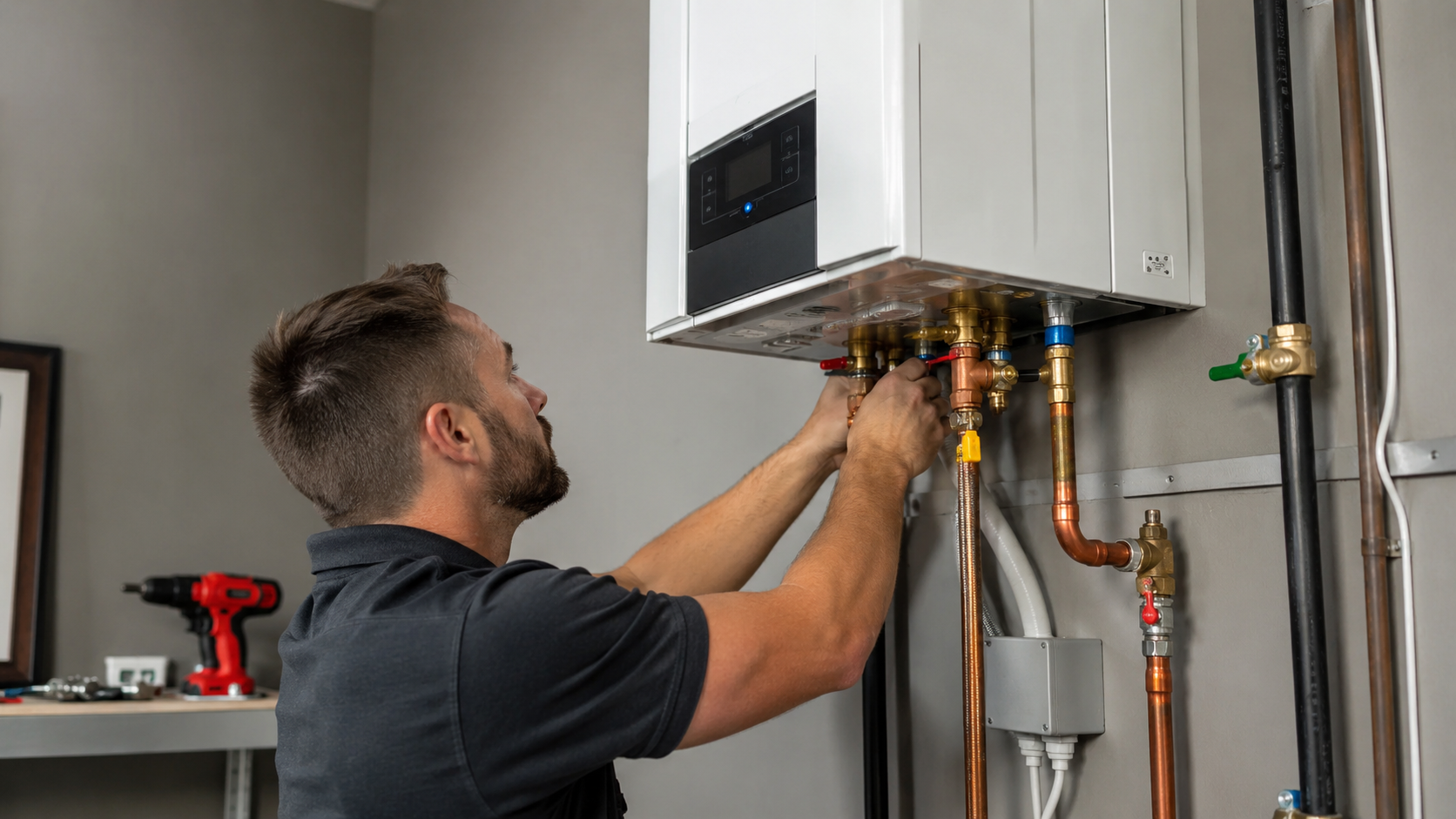
Professional RO installation ensures leak-free connections under pressure, correct faucet drilling without cracking ceramic or stone, and a performance test before the plumber leaves. Miracle Plumbing & AC installs RO systems across Queen Creek, Gilbert, Chandler, Mesa, Tempe, and Scottsdale. Most installations complete in 1 to 2 hours. Call (480) 544-0057 for same-day scheduling.
Frequently Asked Questions
Does a reverse osmosis filter remove PFAS (forever chemicals) from Arizona tap water?
Yes. RO membranes remove PFAS compounds at rates exceeding 90% in laboratory testing. PFAS contamination has been identified in some Arizona groundwater sources, particularly near military bases and industrial sites. If PFAS is a concern for your water source, confirm with your local water utility whether it is present, then select an NSF/ANSI 58 or NSF/ANSI 53 certified RO system for PFAS reduction.
How much water does an under-sink RO system use per day?
Most households use 2 to 6 gallons of RO water daily for drinking, cooking, and ice. A standard under-sink system produces 50 to 75 gallons per day well above household demand. The tank refills automatically between uses. Reject water (3 to 4 gallons per gallon of RO output for a standard system) drains during filtration.
Can I use RO water in a coffee maker or espresso machine?
Yes, and many specialty coffee enthusiasts specifically seek out RO water because zero-mineral water allows coffee roasters to design flavor profiles without mineral interference. However, some espresso machine manufacturers note that very low-TDS water can be corrosive to brass components over time. If this is a concern, a remineralizer stage that adds trace minerals back is recommended.
Will an RO system work with a tankless water heater?
Yes. An under-sink RO system connects to the cold water supply line only and does not interact with your water heater at all. The RO faucet provides cold RO water. Your hot water tap remains unaffected. There is no conflict between RO systems and tankless water heaters.
How long does RO water stay fresh in the storage tank?
RO water stored in the pressurized tank under the sink stays fresh for approximately 2 weeks. The tank is sealed and pressurized, which limits bacterial growth. If you go on an extended trip (2+ weeks), run the tank dry and refill it when you return. Regular daily use cycles the water through the tank fast enough that freshness is never a concern for most households.
Call Miracle Plumbing & AC: Same-Day Service Available
If you need reverse osmosis water filter installation in Queen Creek, Chandler, Tempe, and Scottsdale, Miracle Plumbing & AC has been the trusted local choice since 2008. Kirk Todd’s team is licensed, bonded, insured, and available 24/7. Call (480) 544-0057 or visit miracleplumbingaz.com for a free quote. Same-day service available for most calls scheduled before noon.