What Is Reverse Osmosis: How the Process Works for Arizona Water
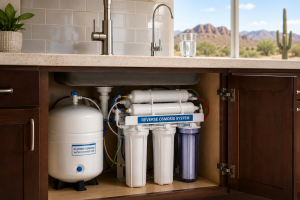
Reverse osmosis is a water purification method that forces water through a semi-permeable membrane under pressure. The membrane has pores measuring 0.0001 microns small enough to block dissolved salts, heavy metals, bacteria, and most chemical contaminants while allowing water molecules through. The result is purified water stored in a pressurized tank beneath your kitchen sink.
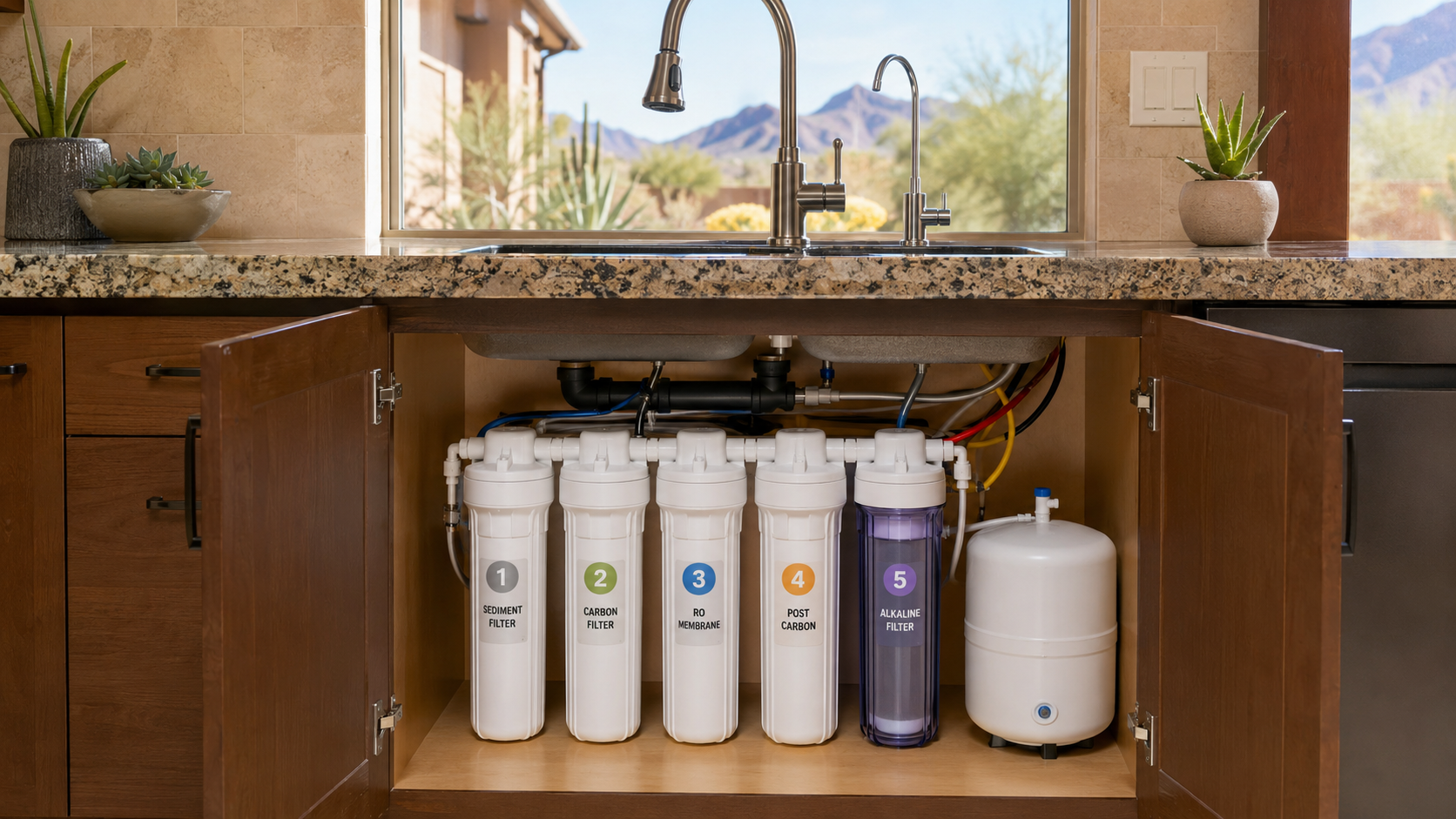
A standard 5-stage under-sink RO system works in sequence. Stage 1 is a sediment filter that removes particles, rust, and debris. Stage 2 is a carbon pre-filter that removes chlorine and chloramines, which would otherwise damage the membrane. Stage 3 is the RO membrane itself, which handles dissolved solids. Stage 4 is a post-carbon polishing filter for taste. Stage 5 is an optional remineralizer that adds trace calcium and magnesium back for flavor.
Arizona tap water is treated with chloramines in addition to chlorine, a disinfection method that requires a specific carbon block pre-filter to remove effectively. A system with a standard granular activated carbon (GAC) pre-filter may not fully remove chloramines before they reach the membrane, shortening membrane life. See our full RO guide for filter selection details.
| Stage | What It Removes | Replacement Interval in AZ |
|---|---|---|
| Stage 1 — Sediment filter | Dirt, rust, sediment, particles | Every 6 months (AZ hard water) |
| Stage 2 — Carbon block pre-filter | Chlorine, chloramines, odors, VOCs | Every 6 months (AZ chloramine treatment) |
| Stage 3 — RO membrane (0.0001µm) | TDS, lead, fluoride, nitrates, arsenic, bacteria | Every 2–3 years |
| Stage 4 — Post-carbon polishing | Residual taste and odor | Every 12 months |
| Stage 5 — Remineralizer (optional) | Adds calcium, magnesium back for taste | Every 12 months |
Table: 5-stage reverse osmosis filter stages, what each removes, and replacement schedule for Arizona conditions
Does Reverse Osmosis Remove Fluoride: The Answer for Arizona Homeowners
Yes. A quality RO membrane removes 85–95% of fluoride from drinking water. This is one of the most searched questions from Arizona homeowners comparing RO systems to standard carbon filters. Standard activated carbon filters do not remove fluoride at all they only remove chlorine, chloramines, and organic compounds. To remove fluoride, you need the RO membrane stage specifically.
NSF/ANSI 58 certification is the independent verification standard that confirms a system removes dissolved solids including fluoride, lead, arsenic, and nitrates. When selecting a system, verify that the certification covers reduction of these specific contaminants not just the membrane’s existence. Some systems are NSF-certified on one stage but not the full system. Look for system-level certification.
Best Under Sink Reverse Osmosis: Why Under-Sink Wins for Most Arizona Homes
For most Queen Creek, Gilbert, and Phoenix Metro homes, an under-sink RO system is the practical and cost-effective choice. It connects to the cold water supply line under the kitchen sink, feeds a dedicated faucet on the countertop or sink, and stores filtered water in a 2–4 gallon pressurized tank. Installation takes 1–2 hours for a licensed plumber.
Under-sink systems produce water faster than countertop units and store it under pressure so the dedicated faucet flows at normal speed. The dedicated faucet is drilled through an unused knockout in the sink or through the countertop a 30-minute step that requires precision to avoid cracking ceramic or stone. Miracle Plumbing handles all faucet drilling as part of the installation.
| System Type | Cost Installed | Flow Rate | Storage | Best For |
|---|---|---|---|---|
| 5-stage under-sink (standard) | $450–$800 | 50–75 GPD | 2–4 gallon tank | Most QC households |
| 5-stage under-sink (high-flow) | $600–$1,100 | 75–100 GPD | 3–5 gallon tank | Large households |
| Countertop RO | $200–$500 | 20–40 GPD | No tank — on demand | Renters, small households |
| Whole-house RO | $2,500–$6,000 | Continuous | Full house supply | Severe contamination, wells |
| Under-sink + remineralizer | $550–$1,000 | 50–75 GPD | 2–4 gallon tank | Those wanting mineral flavor |
Table: Reverse osmosis system types compared for Queen Creek and Phoenix Metro homeowners
Reverse Osmosis vs Distilled Water: Which Is Better for Drinking
Both reverse osmosis and distillation remove a similar range of contaminants, dissolved minerals, heavy metals, bacteria, and most chemical compounds. The end product of both processes is low-TDS purified water. For residential use, RO wins on every practical dimension: cost, convenience, speed, and energy use.
A home water distiller produces 1–3 gallons per day, requires manual operation, uses significant electricity (roughly 3 kWh per gallon), and produces water slowly. An under-sink RO system produces 50–75 gallons per day automatically, stores it under pressure for instant on-demand access, and uses no electricity in normal operation. For Arizona households where drinking water quality is the goal, RO is the clear choice.
How Much Does a Reverse Osmosis System Cost: Arizona Pricing
Under-sink RO systems in Queen Creek and the Phoenix Metro area cost $450–$1,100 fully installed. Equipment runs $200–$700. Licensed installation adds $150–$400. Annual filter replacement costs $80–$200 depending on the filter set, usage volume, and whether Arizona’s hard water and chloramine treatment require more frequent pre-filter changes.
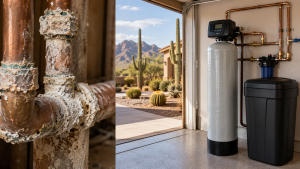
For homeowners who want comprehensive water treatment, pairing an under-sink RO system with a whole-house water softener is the most effective approach. The softener protects all pipes, appliances, and fixtures from scale. The RO system provides drinking and cooking water purified to a higher standard. Running soft water into the RO system also extends membrane life from 1–2 years to 3+ years by reducing the mineral load on the membrane.
Does Reverse Osmosis Remove Microplastics: The Arizona Relevance
Yes. RO membranes remove microplastics at a rate exceeding 99%. Microplastics range in size from 1 micron to 5 millimeters. RO membranes filter to 0.0001 microns four orders of magnitude smaller than the smallest microplastic particle. This makes RO the most effective residential technology for microplastic removal.
Arizona draws heavily from surface water sources including the Colorado River and Salt River, where microplastic contamination has been documented in independent testing. While municipal treatment removes many contaminants before water reaches your tap, RO provides an additional filtration layer specifically suited to sub-micron particle removal.
Frequently Asked Questions
How often do you need to change RO filters in Queen Creek?
In Queen Creek’s hard water environment (12 GPG average) with Arizona’s chloramine water treatment, pre-filters should be changed every 6 months. Post-carbon filters change annually. The RO membrane itself lasts 2–3 years under normal conditions. If the pre-filter has been neglected, the membrane may need earlier replacement visible as a rising TDS reading on the built-in meter.
Should I get a water softener or reverse osmosis system first?
A water softener first, then RO if you want purified drinking water. A water softener protects all pipes, appliances, and fixtures in the home, the most impactful investment for Arizona hard water. An RO system treats drinking and cooking water at a single point of use. Many Arizona homeowners install both: a whole-house softener to protect the home, and an under-sink RO for the kitchen tap.
Does reverse osmosis waste a lot of water?
Standard RO systems produce approximately 3–4 gallons of reject (waste) water for every 1 gallon of purified water. High-efficiency systems reduce this to 1:1 or better. In Arizona, where water conservation matters, a high-efficiency RO system or a system with a permeate pump is worth considering. The overall water volume is modest; most households use 2–5 gallons of RO water daily.
Can I install a reverse osmosis system myself?
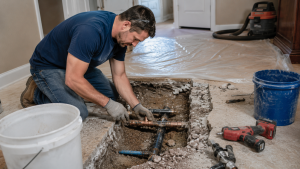
The installation is more involved than most homeowners expect. It requires cutting into the cold water supply line, installing a drain saddle on the drain pipe, and drilling a faucet hole through the sink or countertop. A professional installation ensures leak-free connections under pressure and correct faucet drilling without cracking ceramic or stone. Miracle Plumbing installs RO systems across Queen Creek, Gilbert, Chandler, Mesa, Tempe, and Scottsdale usually same-day.
What does an RO system not remove?
RO systems remove 95–99% of most dissolved contaminants but do not remove dissolved gases including some VOCs and radon that pass through the membrane with water molecules. For dissolved gas removal, an activated carbon post-filter can catch many VOCs. If radon in drinking water is a specific concern (most common in well water), a dedicated aeration system is more effective.
Call Miracle Plumbing & AC: Same-Day Service Available
If you need reverse osmosis system installation in Queen Creek, Gilbert, Chandler, and Mesa, Miracle Plumbing & AC has been the trusted local choice since 2008. Kirk Todd’s team is licensed, bonded, insured, and available 24/7. Call (480) 544-0057 or visit miracleplumbingaz.com for a free quote. Same-day service available for most calls scheduled before noon.