Signs You Have a Slab Leak: What to Watch For?
How Much Does a Water Softener Cost to Install: Component Breakdown
The total cost of a water softener installation in the Queen Creek and Phoenix Metro area has three components: the equipment itself, the licensed installation labor, and the ongoing salt cost. Queen Creek homes averaging 12 GPG of water hardness typically need a 48,000-grain system. Chandler homes at 19.3 GPG usually require 64,000 grains or more.
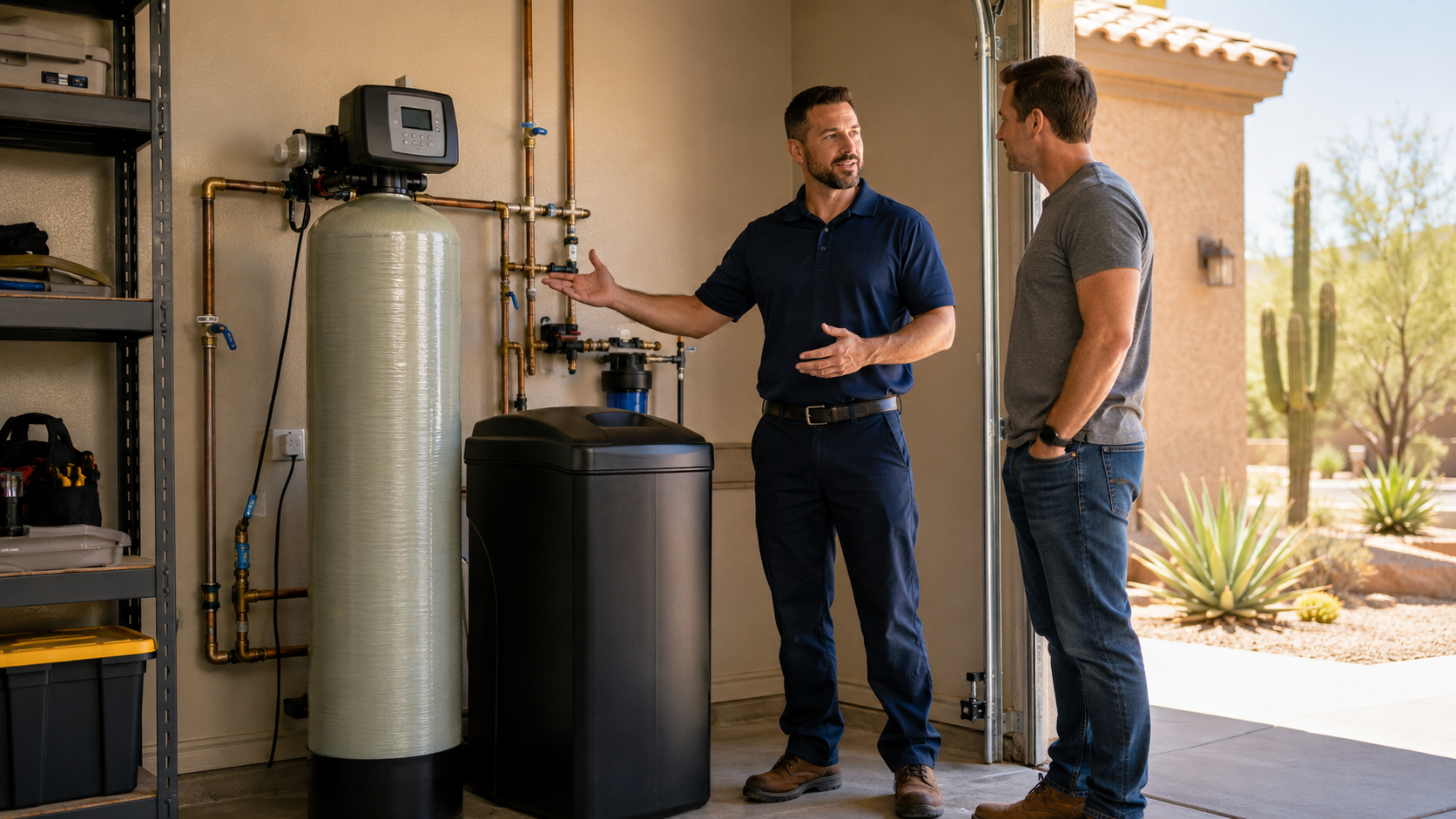
A common mistake is shopping for equipment cost alone without accounting for installation. A cheap unit installed improperly wrong grain size, incorrectly programmed control valve, or a leaking main line connection costs more to fix than the initial savings justify. Miracle Plumbing includes a free water hardness test, correct system sizing, and a written quote covering both equipment and labor before any work begins.
| Cost Component | Low End | High End | Key Driver |
|---|---|---|---|
| Equipment (32,000 grain) | $600 | $950 | Smallest practical size for QC homes |
| Equipment (48,000 grain) | $950 | $1,600 | Standard for 3-4 person QC household |
| Equipment (64,000 grain) | $1,600 | $2,500 | Large household or 15–20 GPG hardness |
| Installation labor (with loop) | $150 | $300 | 1–3 hours, loop already present |
| Installation labor (no loop) | $350 | $600 | 3–5 hours, additional plumbing required |
| Salt (ongoing monthly cost) | $6 | $20 | $6–$12 per 40-lb bag, used monthly |
| Total installed (typical QC home) | $950 | $2,100 | 48,000-grain system with existing loop |
Table: Water softener cost component breakdown for Queen Creek and Phoenix Metro (2025–2026)
Whole House Water Softener Cost Arizona: What Affects the Final Price
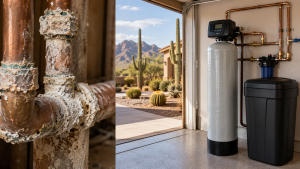
A whole-house water softener treats all incoming water before it reaches any tap, appliance, or fixture. In Arizona, this is the standard approach point-of-use systems at individual fixtures don’t protect your water heater, washing machine, or pipes. The main factors that push whole-house cost higher than the base estimate are: home age (no soft water loop), water hardness (requires larger grain capacity), and any existing plumbing issues discovered during installation.
Homes with an existing soft water loop common in Queen Creek, Chandler, and Gilbert builds after 2005 install faster and at lower labor cost. The loop was roughed in during construction specifically for a softener, so the plumber simply connects to existing stubs rather than cutting into the main supply line. If your home is post-2005 and you haven’t confirmed a loop, it’s worth checking before scheduling it could save you $200–$400 on labor.
Water Softener vs Water Conditioner Cost: Why Cheaper Isn’t Better
Salt-free water conditioners cost $650–$1,500 installed typically less than a salt-based softener. The lower upfront price is the main selling point. But in Arizona, where water hardness ranges from 12 GPG in Queen Creek to 19.3 GPG in Chandler, conditioners cannot keep up with the mineral load. Scale still forms inside your water heater. Dishes still spot. Soap still doesn’t lather properly.
Over 5–10 years, the apparent savings on a conditioner often cost more in appliance repairs and premature replacement than the price difference between systems. A water heater replacement in the Phoenix Metro runs $700–$1,500. If hard water shortens that appliance’s life by 2–3 years, the conditioner’s lower upfront cost is already consumed and then some.
| Feature | Salt-Based Softener | Salt-Free Conditioner |
|---|---|---|
| Total installed cost | $950–$2,900 | $650–$1,500 |
| Removes minerals | Yes — completely | No |
| Protects water heater | Yes — fully | Partially |
| Effective at 12 GPG (Queen Creek) | Yes | Marginally |
| Effective at 19.3 GPG (Chandler) | Yes | No |
| 10-year total operating cost | $1,200–$2,500 | $800–$2,000 |
| Recommended for AZ | Yes | Not for most AZ cities |
Table: Total cost of ownership comparison: salt-based softener vs salt-free conditioner for Arizona
How Often to Add Salt to a Water Softener: Arizona Usage Guide
Most Queen Creek households add salt every 6–8 weeks. The exact interval depends on system capacity, household size, and local water hardness. A 48,000-grain system serving a family of four in Queen Creek (12 GPG average) uses approximately 40 lbs of salt per month. A 64,000-grain system in Chandler (19.3 GPG) may use more.
Water softener salt costs $6–$12 per 40-lb bag at hardware stores and home centers. Pellet-style salt is recommended for most systems it dissolves cleanly and reduces brine tank bridging (a crust that forms above the water level and prevents salt from dissolving). Crystal salt is less expensive but bridges more often. Solar salt is a mid-range option. Miracle Plumbing recommends the salt type best suited for your specific system during installation.
Is a Water Softener Worth It in Arizona: Return on Investment
At Queen Creek’s 12 GPG average water hardness, the return on a water softener investment is measurable across multiple budget lines. Water heaters operating on hard water work 15–20% harder, adding $120–$240 to annual energy costs. Hard water also shortens water heater life by 2–3 years. A single water heater replacement in the Phoenix Metro costs $700–$1,500.
Factoring in energy savings, extended appliance life, reduced soap and detergent use, and avoided plumbing repairs particularly the repiping that aging hard-water copper pipe systems eventually require a water softener in Queen Creek typically pays for itself within 3–5 years. For Chandler homes at 19.3 GPG, the return is even faster because the scale damage baseline is more severe.
Frequently Asked Questions
What is the cheapest water softener option for an Arizona home?
The lowest-cost salt-based option that adequately handles Arizona hard water is a 32,000-grain system, which installs for $750–$1,200 in a home with an existing soft water loop. However, for a household of 3–4 people at Queen Creek’s 12 GPG average, a 32,000-grain unit may regenerate too frequently and wear out faster. A licensed plumber can size the system correctly before you purchase.
How much does salt cost per year for a water softener in Queen Creek?
Expect to spend $80–$200 per year on salt for most Queen Creek households. A family of four using a 48,000-grain system at 12 GPG average uses approximately 40 lbs of salt per month. At $6–$12 per bag, that’s $72–$144 per year — one of the lowest ongoing costs of any home water treatment system.
Does homeowners insurance cover water softener installation?
Standard homeowners insurance policies do not cover elective water softener installation. However, if a failed water softener causes water damage to floors or walls, the resulting damage may be covered under your policy’s water damage provisions — depending on the cause and your specific policy terms. Check with your insurer before filing a claim.
How much does it cost to service a water softener in Arizona?
Annual or biennial service visits from a licensed plumber cost $100–$300 in the Phoenix Metro area. Service typically includes inspecting the brine tank, checking the control valve, testing output water hardness, and cleaning the resin bed if needed. Regular service extends system life and catches problems before they cause a full failure.
What is the most cost-effective water softener setup for a Queen Creek home?
For a standard 3-4 bedroom Queen Creek home at 12 GPG average hardness, a demand-initiated regeneration (DIR) 48,000-grain salt-based softener is the most cost-effective setup. DIR systems regenerate only when needed, saving salt and water compared to time-clock models. Total installed cost is typically $1,100–$1,850, with ongoing costs of $6–$20 per month in salt.
Call Miracle Plumbing & AC: Same-Day Service Available
If you need water softener cost estimates and installation in Queen Creek, Chandler, Gilbert, and Mesa, Miracle Plumbing & AC has been the trusted local choice since 2008. Kirk Todd’s team is licensed, bonded, insured, and available 24/7. Call (480) 544-0057 or visit miracleplumbingaz.com for a free quote. Same-day service available for most calls scheduled before noon.